
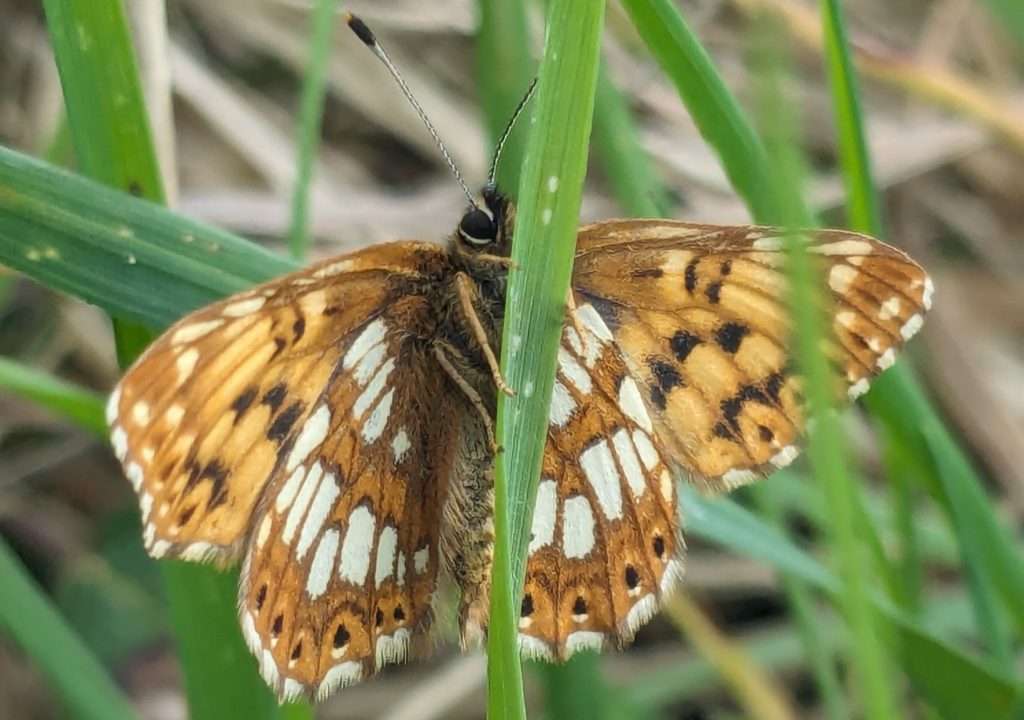
The Duke of Burgundy (Hamearis lucina) is a small brown and orange butterfly whose chequered wing pattern led to it being known in the past as the ‘Duke of Burgundy Fritillary.’ It is in fact part of the ‘metalmark’ family of butterflies and is our only representative of this family in the UK.
Sadly, it is also one of our most threatened butterfly species having seen a dramatic decline over recent years. Since the 1980s its distribution has declined by 89% and it is now mainly restricted to central southern England. Much of this loss is due to a lack of habitat management, either too little grazing or too much, leading to the habitat becoming unsuitable. However, with an understanding of what the butterfly needs and targeted management, it is possible to reverse these declines.
Habitat

The Duke of Burgundy is a ‘habitat specialist’ butterfly, meaning it relies on a specific habitat type and specific larval foodplants, in this case primroses or cowslips. In the past it was primarily a woodland butterfly, found in open sunny glades with abundant primroses, but due to the loss of regular coppicing, many of these colonies have been lost. It is now found mainly on chalk or limestone grasslands where cowslips are the larval foodplant.
Colonies are usually found on west or north facing slopes with tussocky vegetation, rather than short-grazed, sun-baked south facing slopes, as this prevents the cowslip leaves from drying out before the caterpillars emerge. They also require scattered low-growing scrub which provides sheltered perching spots where the territorial males wait for passing females.
Life cycle
The Duke of Burgundy only has one brood per year and are on the wing from late April to late May/early June. Females lay their eggs on the underside of cowslip leaves and caterpillars feed on the leaves at night, leaving a distinctive pattern of feeding damage. Caterpillars pupate in the base of dense tussocks where they overwinter, ready to emerge as the adult the following spring.
Top ID tip

Males and females look very similar and are hard to tell apart. One way is to look at the number of legs. A male only has four functioning legs, the first pair are reduced and no longer used for walking, whereas the female has six functioning legs.
Author: Jennifer Gilbert, Farm Environment Adviser