
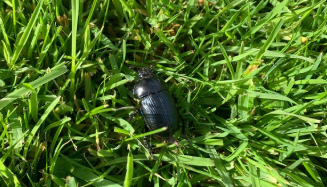
From a business perspective, the numbers are clear. A UK study estimated Dung Beetles save the cattle industry about £367 million per year via reduced pasture fouling, parasite and fly burdens, whilst also improved soil nutrients, before even considering the wider biodiversity benefits.
Dung beetles are highly specialised insects adapted to locate and exploit fresh dung. We have about 60 species in UK but they are struggling and in decline, mainly due to the overuse of wormers which are fatal (or sub-fatal) to them.
Why They Matter – Small Insects, Big Impact on Your Farm Business
Dung beetles are a keystone species in pasture systems and are critical for healthy soil. They have a disproportionately large (and vital) effect on their environment relative to their population size. They maintain ecosystem stability; and are considered an essential asset on every farm as their activity delivers multiple benefits. These insects live and feed entirely within fresh dung on pasture. Some tunnel beneath the pat and bury it. Others live and breed inside it. Together, they process dung quickly, returning nutrients to the soil and restarting grazing far sooner than if the dung is left to sit.
Every grazing animal produces dung. A cow can produce around nine tonnes per year (a sheep, about 800kg per year). Dung beetles determine if dung becomes a waste problem to manage, or a free resource to recycle.
A cow pat can last between 4-8 months on the soil surface without dung beetle intervention and relies entirely on fungi breaking them down. In favourable conditions, with a good population of dung beetles, a dung pat can be reduced by about 70% in a matter of days.
They are the free labour that helps manage a healthy grazing system.
Free Ecosystem Services: What Dung Beetles Do for Pasture
Increase Available Grazing
Livestock avoid dung pats. That reduces usable pasture. When beetles break down and bury dung quickly:
* Grazing returns faster (quicker rotation)
* Fouled pasture reduces
* Grass utilisation improves
Less wasted grass means better productivity from the same acreage.
Improve Soil Structure and Fertility
Tunnelling beetles move dung into the soil profile. This:
* Improves aeration
* Increases water infiltration
* Reduces compaction and need for harrowing
* Incorporates organic matter and nutrients directly into root zones
Better soil structure means stronger swards, improved drought resilience and better water management. A healthier soil reduces pressure to compensate with intervention and artificial methods.
Reduce Flies and Parasites Naturally
Manure is a breeding ground for flies and parasite larvae. Dung beetles:
* Break up and bury dung quickly
* Disrupt parasite life cycles
* Carry mites that feed on fly eggs and maggots
The result is reduced pest pressure.

Reduce Methane from Surface Fermentation
Fresh dung continues fermenting on the surface, releasing methane. Beetle activity mixes and aerates dung, shortening that fermentation period.
That supports climate resilience and strengthens your environmental credentials.
Improves Water Quality
By burying dung directly into the soil soon after deposit via multiple tunnels, they prevent N & P from washing into waterways by taking them down amongst the roots, suppress pathogen load, and reduce soil compaction.
* Reduce surface run-off
* improved rain infiltration
* break the pathogen cycle, significantly reducing the amount of E. coli & Cryptosporidium in surface runoff.
* reduced soil erosion into watercourses
The Bigger Shift: From Blanket Control to System Thinking
Most farms treat flies and parasites routinely and are reactive:
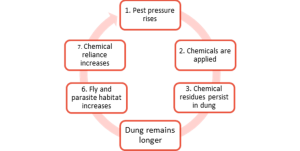
This becomes a cycle. If you change your thinking, you change the cycle. A healthy dung beetle population:
* Removes dung faster
* Reduces fly breeding
* Disrupts parasites
* Improves soil
* Increases grass utilisation
That reduces the drivers that push you towards chemical solutions in the first place. When treatments are proactive in approach, and based on egg counts & targeted treatments, the whole pasture system improves.
What That Means Financially
Changing approach can lead to:
* Reduced need for blanket worming (use faecal egg counts and targeted treatment instead)
* Lower fly control costs
* Less need for mechanical harrowing
* Improved grass growth from better nutrient cycling
* Potential reduction in bought-in fertiliser over time
Less chemical input means:
* Lower purchase costs/increased profitability
* Reduced exposure risks for livestock and operators
* Healthier soil biology
* Greater resilience
When systems function properly, you spend less correcting problems.
Practical Changes That Support Both Beetles and Business
* Avoid routine blanket worming; use targeted, evidence-based treatment
* Speak with your vet about lower-impact parasite control options
* Maintain permanent pasture where possible
* Retain functional hedgerows and field connectivity
* Avoid unnecessary soil disturbance
* Keep some grazing animals out year-round if feasible
These are not radical steps; they are changes in approach. A lower intervention ‘light touch’ approach is a refinement that allows natural processes to work for farming.
Creating more favourable conditions for Dung beetles means farmers can choose to strengthen the underlying biological engine of their farm, as an alternative to continued management of symptoms with chemical inputs and costs.
Dung beetles are not just another insect, they are free labour improving soil, reducing pests and cycling nutrients every day.
Many UK species are in trouble, largely due to how we manage grazing and veterinary medicines. With smarter pasture management and a more considered, targeted use of veterinary medicines, we can rethink how and when we intervene, reducing unintended harm to beneficial insects and allowing natural processes to carry more of the load — building a more resilient, biologically active and ultimately more profitable farming system.
Impact of Parasiticides on Dung Beetles
Dung Beetles populations are threatened by chemical parasiticides (wormers) used on livestock. Specifically, Macrocyclic Lactones (e.g., ivermectin) are highly toxic to dung beetles. A sustainable, integrated pest management (IPM) approach using targeted, rather than routine, treatment is recommended to balance parasite control with beetle conservation.
- Toxicity: Residues of parasiticides excreted in dung can kill, or cause sub-lethal effects (e.g., reduced breeding, lower flight capacity) in, dung beetles.
- Vulnerability: Tunnelling dung beetles are particularly vulnerable to chemical residues in dung.
- Worst Offenders: Avermectins (including ivermectin) and synthetic pyrethroids are highly toxic, while other treatments like fenbendazole have lower toxicity.
- Persistence: The negative impact on beetles often lasts longer than the treatment’s effect on parasites.
The use of certain conventional parasite treatments will diminish beetle populations when used inappropriately. These treatments are either lethal or sub lethal. You may still see dung beetles in your dung pats but the wormers will have affected their ability to reproduce.
Beetles reduce parasite numbers. Wormers reduce beetle populations. So, when we use wormers in a bid to control livestock parasites, we inadvertently hamper the natural role of dung beetles in parasite control.
SUSTAINABLE MANAGEMENT PLAN
- Treat only parasite the burden, not an assumed burden
- Faecal egg counts and blood tests fine tune your approach
- Breeding plans – increase naturally resistant animals/Limit animals that are susceptible to parasite burdens
- Discuss less toxic pesticides and control plans with your vet
- PREVENT – ASSESS – TREAT (PAT)
- Accurate animal ‘weight for dose’, no guessing
- Keep animals of clean pasture for at least a week post-treatment
- Tighten up biosecurity
- Introduce stock/pasture rotation, breaks parasite lifecycle and reduces parasiticides residence
- Don’t treat all stock at once to ensure there is some non-toxic dung available
- Plant high fibre grasses and natural anti-parasitics (such as chicory, sainfoin, plantain, birdsfoot trefoil, willow)
Habitat and Behaviour
Using clubbed antennae that open like fans, dung beetles can detect dung from up to two miles away. Their antennae maximise surface area for scent detection, enabling rapid arrival at fresh pats.
They have powerful, flattened forelegs for digging and shaping dung, and complex split eyes that process information from above and below simultaneously. Many species bury dung in tunnels beneath the pat, forming brood balls—each ball provisioned with one egg. Others lay eggs directly within the dung.
The life cycle is simple and complete (egg → larva → pupa → adult.) Adults do not grow after emergence. Larvae are C-shaped grubs that develop entirely within dung or underground brood chambers.
Dung beetles are ancient. Fossil evidence shows they were associated with dinosaur dung and later followed large grazing mammals across post-Ice Age landscapes into Britain.
Dung beetles use freshly deposited dung only. They do not colonise farmyard manure heaps, slurry, or stored muck, or manures and slurries when they have spread on the fields. Once dung is collected and its temperature and microbial community altered, it becomes unsuitable habitat.
Most tunnelling species are active at night. Adults are highly mobile and transient, emerging and flying to locate new dung resources as they appear.
Hedgerow structure and landscape connectivity matter. Some insects, including dung beetles, fly at specific heights and require gaps or varied boundary structures to move across farmland.
TYPES: Main UK Groups
The UK has three main functional groups:
- Geotrupes (earth-borers or tunnellers) – Larger, usually black beetles. They tunnel deeply beneath dung and bury significant quantities.
- Onthophagus (“horned” dung beetles) – Smaller tunnellers; some species have distinctive horns and favour pelleted dung such as sheep or deer.
- Aphodius (dwellers) – A diverse group (40+ species), usually smaller, many living and breeding within the dung pat itself.
Unlike tropical regions, the UK has no true dung rollers. Lower competition for dung in temperate climates means most UK species work beneath or within the pat rather than rolling it away.
Identification to species level is difficult and influenced by size variation, colour differences, soil type, and climate. Recognising functional groups and body shape is often more practical than precise species ID.
https://www.dungbeetlesforfarmers.co.uk/ is an excellent resource available for farmers.
For more information on worm control visit: http://www.scops.org.uk/ or http://www.cattleparasites.org.uk/