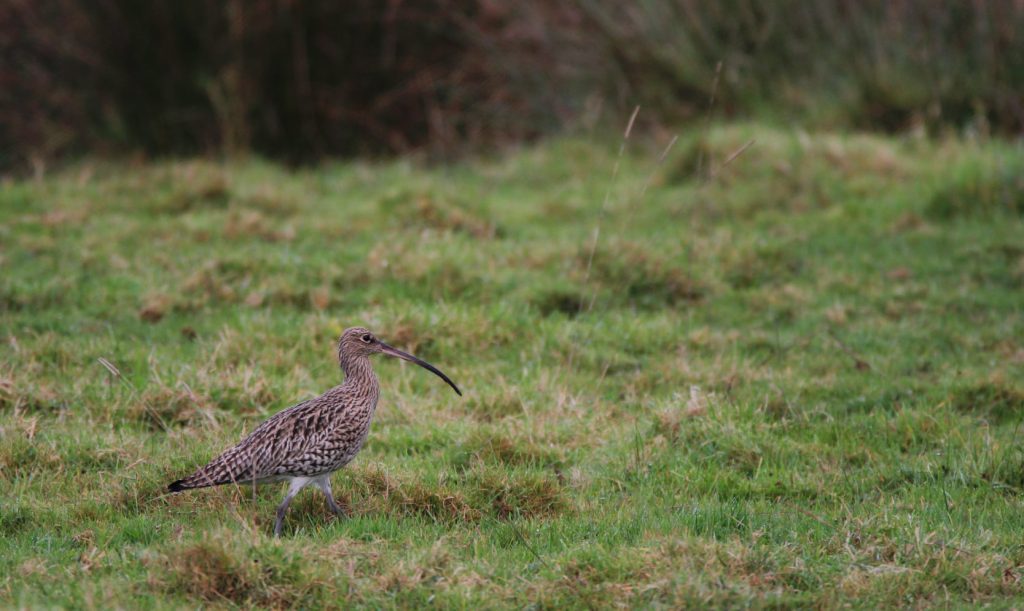
From 2025 to 2026 FWAGSW are involved with Kernow Curlew; a local partnership working to protect the last breeding Curlew in Cornwall. This groups includes the Cornwall Birdwatching and Preservation Society, FWAG South West, South West Lakes Trust, local artist and Curlew conservationist Jennie Hale, and several dedicated landowners. Together, we’re combining conservation knowledge, farming experience, and community effort to give these iconic birds a fighting chance.
Curlew is the UK’s largest wading bird, recognised by its long, distinctive down-curved bill and loud, haunting call. It was once widespread across England, but since the 1980s has suffered significant declines leading to its classification as a Red-listed species of conservation concern.
Although Curlew still breeds in many areas of northern and western Britain, their range has significantly decreased leaving isolated populations in the south, southwest and southeast.
In winter, UK-breeding Curlews can be found all along the coast and surrounding farmland, joined by large numbers of migrants from Fennoscandia, leading to a significant spike in the number of Curlew recorded in the UK.
Curlew in Cornwall
J Clark’s 1906 publication noted an abundance of breeding Curlew in Cornwall, however now the county represents a small, isolated fragment of the Curlew’s breeding range in the UK. While the county once supported multiple breeding sites, Bodmin Moor is now the last known stronghold where the species breeds. As of 2024, just a handful of farms on the moor have recorded breeding attempts, which resulted in only two chicks successfully fledging. This means that Cornwall’s breeding Curlew are very close to extinction
Now that many of the Curlews that once bred in Cornwall are gone, the birds’ traditional connection to the land is being lost.
Kernow Curlew Key Priorities
- Further the knowledge and understanding of the populations and distribution of Curlew in Cornwall
- Work collaboratively with existing groups and landowners to investigate and, where feasible, implement measures to protect the existing population
- Investigate and apply methods to enhance habitats and conditions that encourage increased breeding success
- Encourage and facilitate the recording of Curlew sightings
- Support public education and raise awareness about Curlews and their conservation
Threats to Curlews in Cornwall
- Habitat loss: Fires, changing land-use and intensive practices have all caused an alteration of the natural landscape. This has led to a loss in historic and appropriate nesting locations.
- Tree-planting: Afforestation, particularly with Sitka Spruce conifer plantations on Bodmin Moor, creates habitats for generalist predators such as foxes and Carrion Crows.
- Predation: Eggs and chicks are vulnerable to predation from foxes, crows, and badgers. The UK has some of the highest densities of foxes and Corvids in Europe.
- Disturbance: Human activity (e.g. dogs off leads), especially during the breeding season, can disrupt nesting and lead to failure.
Breeding Habitat on Bodmin Moor
Much of the moor is currently unsuitable for breeding Curlew with large conifer plantations, dry moorland and overgrazed grassland.
Curlew breeding on Bodmin Moor are closely associated with specific habitat features:
- Grassland and unimproved moorland: Typically, grazed by cattle to maintain a balance of open areas and tussocky spots for nesting and hiding.
- Edges of pools, lakes and marshes: Areas where small marshes are adjacent to both a lake and rough grassland.
- Heathland: Provides additional structure and cover.
More Information can be found at www.cbwps.org.uk/Curlew
Email: cornwallteam@fwagsw.org.uk