
In August our team of Somerset judges, Ben Thorne, Zara Blackmore and John Gilbert, set out on our Somerset Otter Awards judging tour of three finalists. Read on to find out more about each of the farms and the judge’s decision as to who they crowned winners for 2024.
Dillington Estate- Ilminster
Dillington Estate have worked hard over the past few years to turn an arable and dairy farm enterprise into a farming system that produces sustainable food and complements the environment. They strive to create a ‘synergy between food production and environmental benefits’ with the ultimate aim of reaching net zero.
The estate boasts a Mid-Tier Option or SFI (Sustainable Farming Incentive) action against every land parcel on the estate. They were previously in a Higher-Level Scheme agreement for 15 years, are LEAF accredited, Red Tractor assured and an AHDB Strategic Dairy Farm with an environmental focus.
All farm buildings have solar panels as well as a small-scale slurry-fed aerobic digester (AD) plant, both of which help reduce their energy consumption. Furthermore, Dillington have been auditing their carbon footprint for the last 2 years (through Kite Consulting), to look at alterations that could be made to the farming system to help reduce energy consumption. Farm manager, Ollie Blackburn, explained that through relationships with local AD plants and altering the cropping rotation, they have been able to reduce their nitrogen fertiliser purchasing from 12 loads per year to four. They have also found that the inclusion of herbal leys, being a nitrogen fixing crop, has increased fertility of the ground.
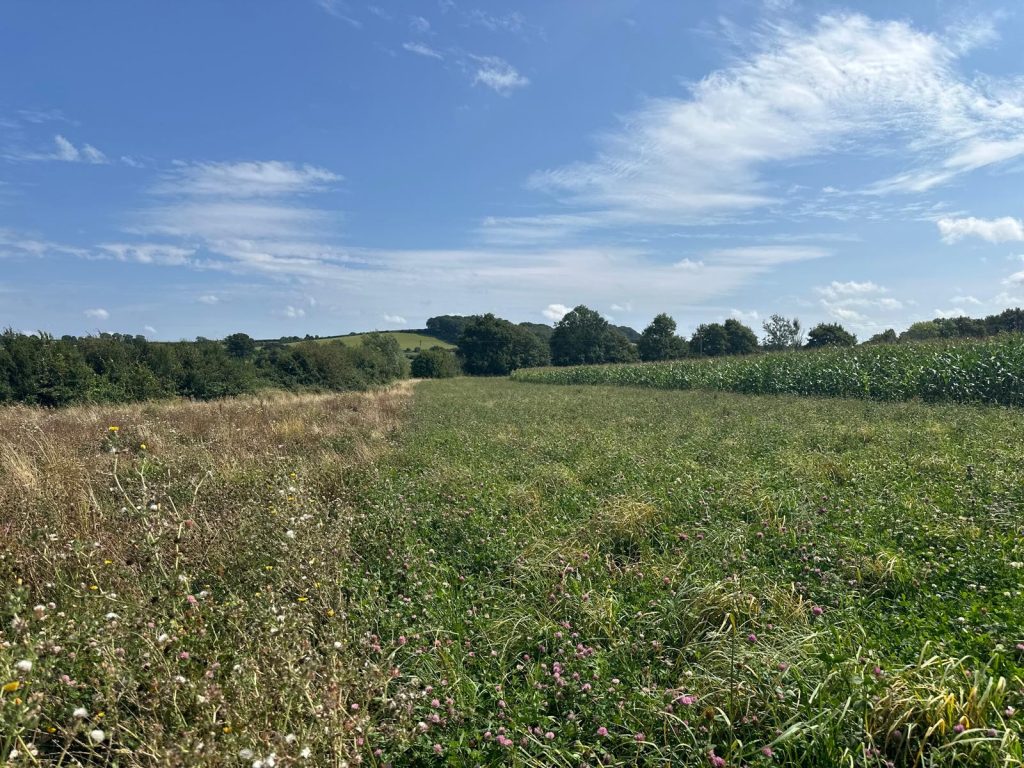
The judges were particularly impressed by the headlands surrounding each field, some of which reached a width of 15 meters, and are in herbal leys. As well as preventing run-off around their crops such as maize, they are cut up to 3 times during the season to produce silage for the cows and youngstock, and it smelt wonderful! These combinable crops were buffered in certain areas with wildflower alternatives on the more marginal and stoney land, and winter bird feed in addition to the herbal leys. Furthermore, the herbal leys have improved the yields of combinable crops and increased the amount of organic matter. The hedges are on a three-year cut cycle and are of a significant size, no doubt making a fantastic home for birds. Numerous bees, butterflies and other insects were spotted throughout the visit, demonstrating how successful this has been in drawing insects and species to the area.
Dillington Estate knew that they had poor soil condition on parts of the farm previously. To rectify this they have been growing cover crops for the last 10 years and direct drill into maize to prevent erosion and lower the risk of machinery damage. But now the soil is in a much better condition, being ‘looser and crumblier’. They also utilise modern technology such as NRI sensing, which allows a precise application of organic nutrients and never exceeding the amount needed.
In addition to all of this, the estate host home education sessions and welcome a small forest school with plans to host educational visits. The aim is to show children how the farm works and that quality food production does not have to be at the expense of the environment.
When it comes to future plans, Oli stated that he was happy with how everything is working in conjunction with one another. They would like to grow more protein bi-crops to reduce the dependence on imported proteins to support both milk and beef production and are in discussions with Green Ilminster to conduct bird and wildlife survey across the estate. But overall, the continuation of developing a sustainable farming system that is ‘fit for the future’ is of utmost importance.
Holly Purdey and Mark Brewer- Horner Farm, Porlock.
Horner Farm, based on Exmoor and bordering Dunkery Beacon and the coast in the Porlock Vale, was at a complete contrast to the other farms the judges visited. The farm is in a variety of schemes; Mid-Tier, Higher Tier, SFI and the pilot Landscape Recovery scheme. Running their farm as a healthy, functional ecosystem, Holly and Mark adapt their practices to the environment rather than forcing it to change. They maintain a low input, low output system. The farm is a blend of grassland swards- permanent pasture and herbal leys, which are sown without disturbing the soil, and are creating two species-rich meadows. They are currently undergoing the organic conversion process. Alongside this, there is also wood pasture at the top of the farm and newly planted silvopasture at the bottom.
Holly and Mark took on this farm 6 years ago, with ‘significant compaction, poor organic matter and low species diversity’, but have since turned that on its head through altering the management of the land. The land is grazed by native breeds of sheep and cattle, including the rare breed Gloucester cattle. All are outwintered (meaning there is no need to bring straw or food in) and therefore grazed extensively at low stocking numbers across the 78ha. The future goal is to have 60:40 grazing livestock (cattle to sheep).
Holly is investigating the possibility of weaning animals naturally, but for now, she uses stress boards to keep the animals’ calm. The livestock receive a bolus with the necessary minerals and vitamins and have a mineral lick available but receive no Ivermectin wormers. When it comes to fly treatment, Holly and Mark have created their own organic fly repellent. There are also goats on the farm which are fantastic for natural weed control and ultimately reduce carbon emissions due to the absence of machinery.
With a strong emphasis on education, Horner Farm welcomes school and community groups for tours and farm visits, which they can provide at no cost thanks to funding from FiPL (Farming in Protected Landscapes) and Countryside Stewardship Schemes. They believe it’s critical that people understand where their food is coming from and encourage the next generation to take care of the environment. This entails preparing a few meals and providing recipe cards with ingredients that are affordable but nutritious. Holly visits the producer’s market once a month with her locally slaughtered meat and free-range chicken eggs and produces 30 veg boxes a week from the vegetable garden.
The farm is heavily focussed on reducing any environmental impact. This means that they do not make haylage or silage, just hay so there is no need for it to be wrapped. Holly ensures the livestock licks and chicken feed are palm oil and soya free, and a considerable effort is made to avoid using machinery on the land wherever feasible. The farm has undertaken a farm carbon toolkit assessment and there is a programme of monitoring regularly undertaken. This includes grassland species baseline data, soil and carbon data, barn owl, bat, butterfly, reptile and occasional bird surveys.
Numerous techniques have been used to expand and develop habitats. To encourage the development of natural scrubby areas and soften the edges of the hedges, fencing has been moved further out into the field. Hedges have been planted on traditional hedge lines across the farm and widened to help build wildlife corridors. There has been a section of wood pasture planted with the hope of increasing resilience to the future climate, and this is going to be further developed in 2025.
A considerable amount of natural flood management work has been carried out across the farm and there has been creation of flow ponds and blocked ditches which will help hold water on the land in times of drier weather, but also slow the flow and mitigate downstream flooding.
https://www.horner-farm.co.uk/
Ben Turner- Camel Hill Farm, Yeovil.
Camel Hill Farm has been focused on regenerative farming for the last 7 years and use a zero-tillage planting approach. They utilise a combination of herbal leys, hay meadows, cover crops and species rich grassland. This has resulted in noticeable improvements in the soil quality throughout the farm. Similarly to the previous 2 farms, they are in a Mid-Tier and SFI agreement but are also in the second year of a biodiversity net gain scheme and Red Tractor Farm Assured. The choice was made to switch from planting oil seed rape to a legume fallow instead, which is deeper rooting, drought resistant and allows the soil to recover. Under a scheme, Ben has decided to put just under half the area of the farm into species-rich grassland, on what was arable land and temporary grass, and it is hoped this will further improve the current habitat on the farm.
The number of habitats was impressive and included rough pasture, hay meadows, parkland/wood pasture and a nut orchard, and all are home to an array of birds and wildlife including hobby’s, barn owls, kestrels, lapwing, great crested newts and brown hairstreak butterfly to name just a few!
Over a kilometre of hedges have been replanted and fencing has been done some distance from certain hedges to allow a rough, tussocky area to develop. Interestingly, part of the farm lies on top of a Bronze Age and Romano British village and previously formed the area of a deer park connected to Hazelgrove House.
Camel Hill Farm produces 35kw of solar electricity from panels on the roofs which helps to power the grain drying store. Ben has seven native South Devon Cattle which are extensively grazed alongside 50 sheep to help manage the grassland and improve soil quality. There are kestrel boxes on the barns, and it was noted that it would be unusual to visit the farm and not see one. Ben has done considerable work for water management, including new ditching around certain fields and two ponds which were abundant with life. The judges walked through a series of fields and were impressed with the variety of species within them and the amount of wild carrot. It was interesting to hear about the changes this farm has undertaken, and the significant number of ecological and wildlife surveys undertaken, which is proving that the changes made have had a positive impact on the farms environment.
https://www.camelhillfarm.co.uk/
The judges were very impressed with the quality of entrants for this years competition, each uniquely playing their part in making space for nature on their farms.
The winners of the 2024 Somerset Otter Award are Dillington Estate with Horner Farm as runners-up!
We very much look forward to welcoming you to Dillington Estate in 2025 to celebrate their success and find out more about their various enterprises.