

Author: Joanna Uglow.
If you asked someone to describe a dung beetle, they would probably paint a picture of a shiny black beetle rolling a ball of dung across a desert. While this type, known as rollers, are common in warmer climates of the southern hemisphere, we have dwellers, tunnellers and stealers making up 60 species here in the UK.
As part of an initiative on Exmoor to provide farmers with one-to-one training on soil assessments, we have worked on a few holdings that are interested in investigating dung beetles.
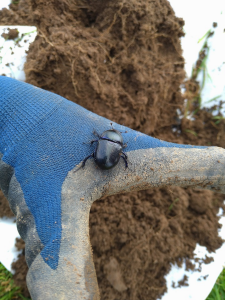
Why should we care about dung beetles?
Well, they provide multiple benefits to pastures. They rely completely on dung as a food source, foraging in fresh dung to feed young or taking it down below the soil surface as deep as a metre. Because of this, they are important players in recycling nutrients and improving soil structure and organic matter, as well as reducing parasite burdens to livestock within pastures.
Changes in land management have put many dung beetle species at risk. Cultivations and loss of permanent pastures to shorter-term leys and arable rotations disrupt their life cycle and disturb the soil. Changes in livestock diets, including fibre content, alters dung consistency which can make dung pats less habitable for them. The use of fertilisers and parasite treatments also harm these insects.
What can you do to support dung beetles on your farm?
Here are a few suggestions that can help, as well as providing wider benefits to the farm business and ecosystem.
- Consider areas of permanent pasture across your holding and ensure they’re well connected.
- Think about sward diversity, consider over-sowing or using a more diverse seed mix if re-seeding to add fibre into the diet. A wider range of grass species will also provide minerals and trace elements in livestock diets and increase crop resilience.
- Hedges and silvopasture don’t only offer shelter for livestock but also provide shady habitats which are favoured by some dung beetle species.
- Carry out Faecal Egg Counting to move towards less reliance on wormers, to improve animal health and to reduce business costs.
Where can I learn more?
Whether you’re aiming to increase dung beetle numbers or generally making changes to positively impact your farm and the environment, dung beetle surveys could be one thing to monitor. Equipment needed is basic – a spade, plastic box, sieve and a spoon are enough to carry out an assessment.
The Dung Beetles for Farmers website has a wealth of resources including information about how to survey, as well as Dung Beetle UK Mapping Project (DUMP) where you can find identification keys.