Author: Kate Harris (Communications Officer) & Jacky Cherry (Cornwall KAS Coordinator)
Target Audience: Schools, public, farmers, funders.
Introduction
The Cornwall Kingfisher Award Scheme (KAS) began in 2008 and each year since has supported nearly 300 children from 6 schools to get out on a local farm and see for themselves how food is produced and what lurks beneath the soil under our feet.
In 2024 we were welcomed to Pencoose Farm by the Gluyas family who grow arable crops, keep livestock and produce electricity from their solar farm.
The challenge
As a nation, we’ve never been more disconnected from how our food is produced or the people who produce it. Easy access to processed food from large retailers means that many children grow up not knowing where grains, vegetables, meat or dairy products come from nor the environment in which they’re produced. Understanding food production and the environment in which food is grown allows children to make better informed choices around eating habits, sustainability and climate change.
The Kingfisher Award Scheme gives children the opportunity to “touch, feel and see the relationship between food, farming and wildlife.”
Kingfisher Field Days
Each year, Cornwall KAS gives 6 schools the opportunity to visit a local farm for a half-day field visit. We alternate our host farms every 2-3 years to give a wide range of schools the chance to take part. In June 2024, 280 children aged 8-11 from 6 primary schools near Stithians were welcomed to the farm where this year’s theme was ‘Farming and Wildlife in the modern world’.
Jacky Cherry coordinates the Cornwall Kingfisher Award and every year is amazed by the enthusiasm of the children from the minute they step off the bus. ‘I appreciate the challenges of taking children on field trips’ she says. ‘Coordinating transport, managing risk, finding enough volunteers, providing facilities – they all add to the pressure, but the rewards are worth it’.
The children and teachers were split up into groups; we recommend between 8 and 10 children per group to allow everyone to get involved and see what’s going on. Each group moved around 4 different activities on the farm, led by volunteers who encouraged them to ask questions and helped to keep them focused!
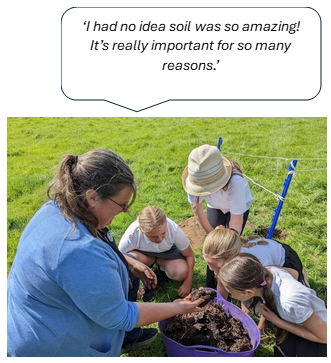
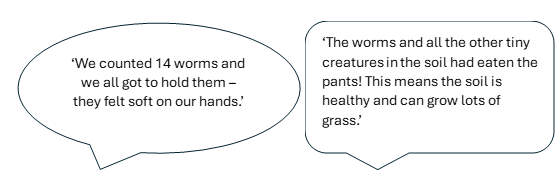
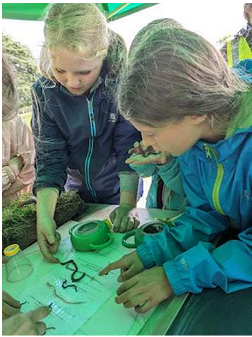
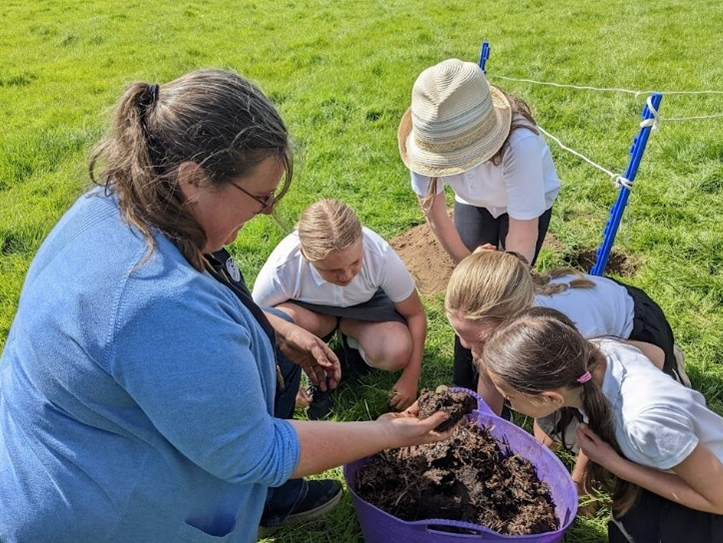
Louise Wallace, FWAGSW Education Officer, led the soils activity titled ‘Where’s that worm?’, where the children were encouraged to plunge their hands into a bucket of soil and describe it in as many words as they could. Next, they were on the hunt for worms in a freshly dug hole and we looked at how worms and other living organisms work so hard to create fantastic soil for growing crops. ‘We buried some cotton underpants on the farm a few weeks ago in different fields,’ explained Louise, ‘and now we can show the children how microbes and bacteria in the soil have broken down the material – the more degraded the pants the healthier the soil!’
Here are some photos and quotes from the children during the field days.