
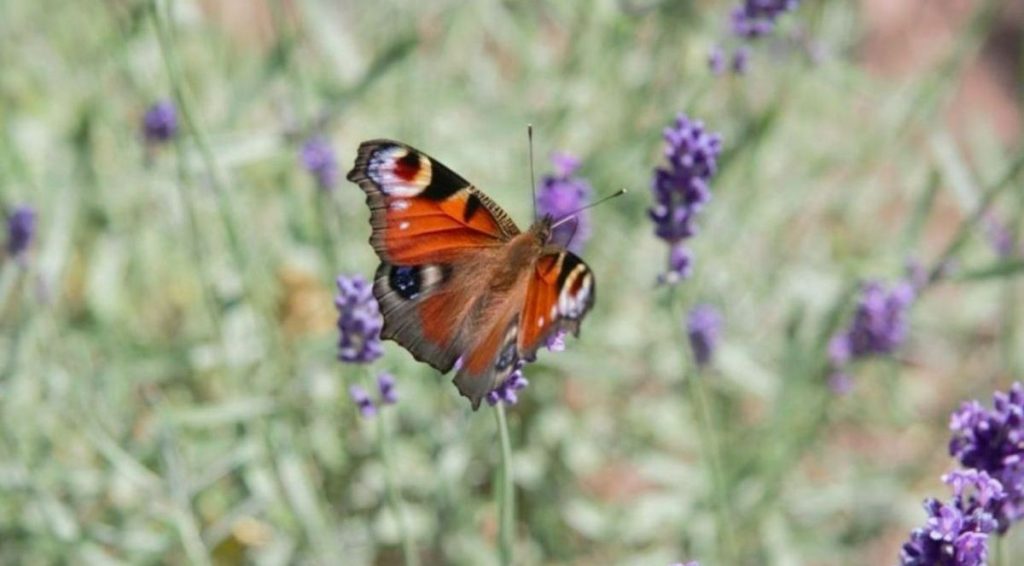
Following an on-farm event at Lower Hampen Farm in Gloucestershire in August this year, Farm Environment Adviser Jennifer Gilbert explores how you can support butterflies on your farm.
Looking after our butterflies is becoming increasingly important as we continue to see declines in our UK populations. Since 1976, 80% of our butterfly species have decreased in either abundance, distribution or both*. As perhaps expected, habitat specialist species, those that are restricted to habitats such as calcareous grasslands and heathlands, and have specific ecological requirements, have suffered the largest declines. Wider countryside species, those that are found across a variety of habitat types and are generally more common, however are also seeing declines. As butterflies are indicators of a healthy environment and are important pollinators, these trends highlight a need not only to focus on our rarer species, but to look after all our butterfly species.
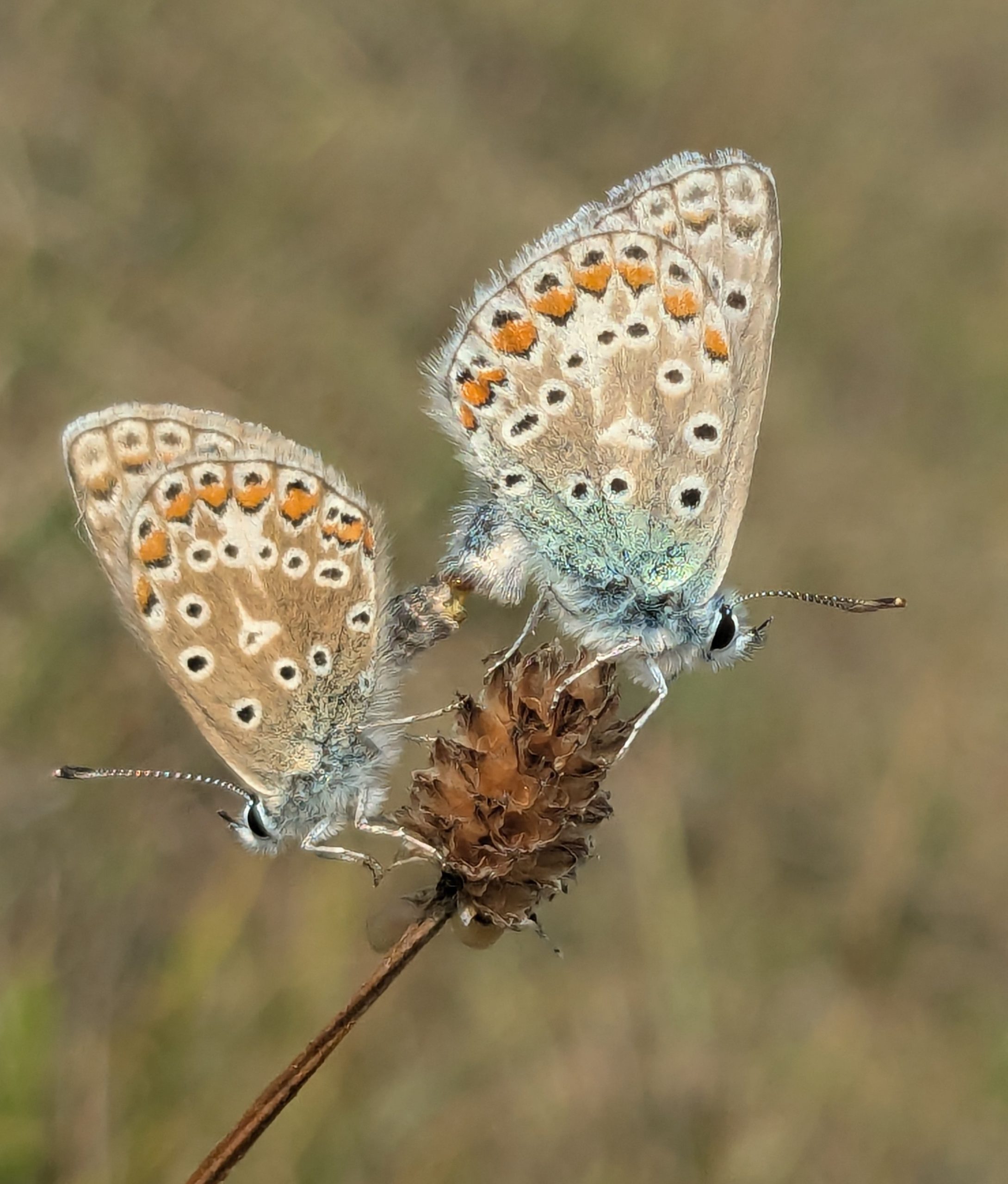
A mating pair of common blue butterflies seen recently by Jennifer Gilbert whilst carrying out a survey.
Our ‘Supporting butterflies on your farm’ event hosted by Lydia Handy at Lower Hampen Farm, aimed to show participants how practical measures to support butterflies can fit in with and support the wider farm environment.
Butterflies need different things at each stage of their life-cycle so it is important to provide for them year-round. As adults they need nectar-rich plants from which they get their energy, the caterpillars need specific foodplants on which to feed and grow, and all species need areas where they can overwinter. Different species see out the winter in different life stages e.g. as an egg or caterpillar, but all need undisturbed areas (e.g. long tussocky grass) in which to do this.
Our walk around the farm allowed us to see a variety of habitats that supported each of these life stages.
Hedges
Hedges are hugely important to wildlife and if managed well can provide a range of resources for butterflies.
- Nectar sources from trees and shrubs that make up the hedge such as hawthorn and blackthorn as well as plants around the base of the hedge.
- Foodplants for the caterpillars of common species such as Brimstone (buckthorn/alder buckthorn) and Holly Blue (holly) as well as rarer species such as the Brown Hairstreak (blackthorn).
- Overwintering areas. Allowing the base and margin of a hedgerow to grow up with tussocky grasses and keeping them uncut through winter provides undisturbed refuges for butterflies to see out the winter months. Brown Hairstreaks however overwinter as eggs laid on the younger branches of blackthorn. Cutting hedges in winter can therefore be very detrimental to these butterflies so leaving a third of the hedge uncut every year can help support this species.
Field margins
Field margins, corners, strips or other areas set aside as grass or for wildflowers can also provide for one or more life stages.
- Nectar sources from a variety of wildflowers such as black knapweed, field scabious and ox-eye daisy.
- Larval foodplants for species such as Orange Tip (garlic mustard), Common Blue (bird’s-foot trefoil), Peacock (nettles), Gatekeeper and Small Skipper (grasses).
- Overwintering areas – if some areas are left uncut over the winter months.
Tree planting
- Whether for new hedgerows, creating copses or agroforestry, planting a variety of tree species rather than a monoculture will allow for both nectar and larval foodplant provision. As well as supporting several of our butterfly species, trees also support a wide variety of moth species e.g. the Purple Thorn whose caterpillars feed on hazel.
- Keeping open grassland areas within the new planting can also continue to provide grasses and wildflowers for nectar sources, larval foodplants and overwintering areas.
Beetle banks
- These tussocky grass banks can provide larval foodplants for many butterfly species such as Ringlet, Meadow Brown, Marbled White and Large Skipper whose larvae feed on grasses.
- Being left uncut will again provide those refuges for overwintering and general shelter on rainy/windy days.
As well as providing nectar, foodplants and shelter, all these features provide an additional benefit to butterflies and a wide variety of other wildlife – connectivity through the landscape. Linear features such as hedgerows or ‘stepping stones’ such as wildflower field corners enable butterflies to move through the landscape. This is vital to avoiding local extinctions, enabling species to find new habitats to colonise and to sustain healthy populations.
These features can also support the farm business itself by providing services such as flood and erosion risk management. Beetle banks that split up large fields, hedgerows and tussocky grass strips can all help slow the flow of water and prevent loss of soil and costly inputs. In addition, adding in wildflower and grassy margins can help support various crop pest predators (beneficial insects) and can be used as part of your Integrated Pest Management (IPM) strategy.
Other aspects to consider in supporting butterflies include reducing pesticide use, creating sunny rides through woodlands and leaving patches of nettles in sunny spots. Although this may look untidy, nettles are the main foodplant of the Red Admiral, Peacock, Small Tortoiseshell and Comma butterflies, while patches of thistles also provide the foodplant for Painted Lady butterflies. For more information on supporting butterflies on farms see this link.
To see more about Lower Hampen Farm, their produce and to read their regular blog visit https://www.homegrownathampen.co.uk/.
*taken from The State of the UK’s Butterflies report 2022