
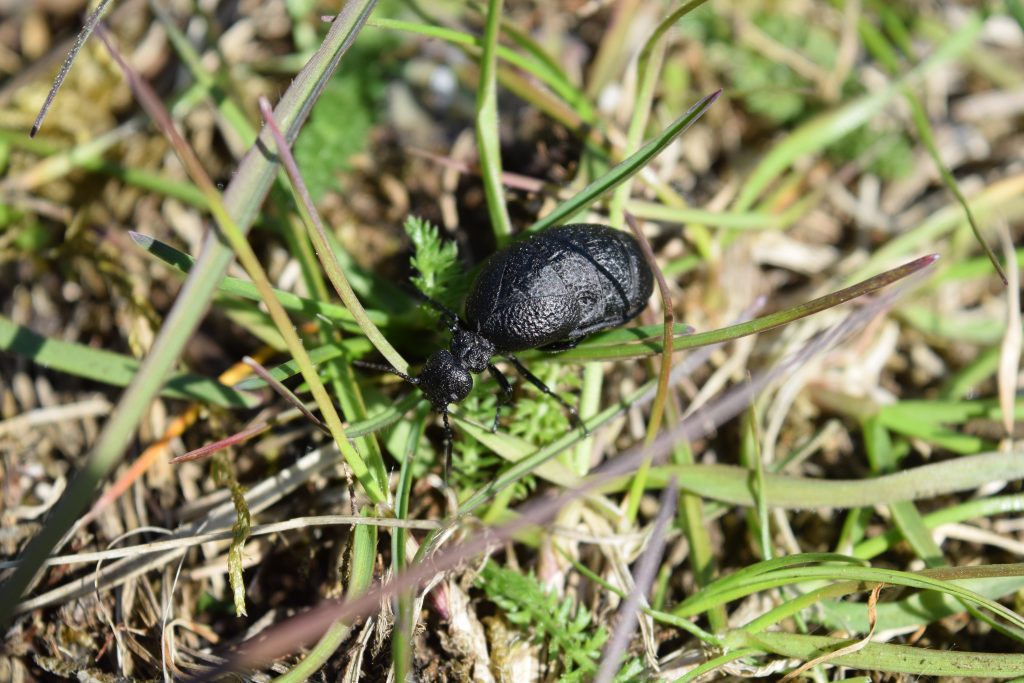
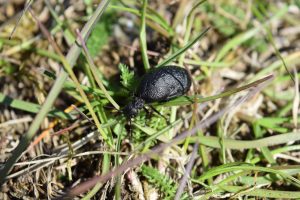
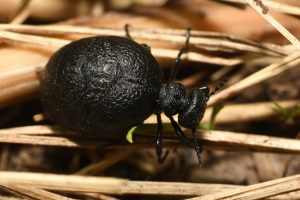
The Rugged Oil Beetle (Meloe rugosus) is one of only five oil beetle species in the UK and is one of the rarest. They have seen a decline in both their range and abundance and are now only found in parts of southern England and south-east Wales. Here in Gloucestershire, we are lucky enough to have one of their strongholds on the limestone grasslands of the Cotswolds.
Oil beetles get their name from the distasteful oily substance that they secrete from their knee joints to avoid being eaten by predators. The two more common species, the Black and Violet Oil Beetles are active during the daytime in the summer months and are more likely to be encountered when out walking in the countryside. Rugged Oil Beetles however are nocturnal and only active during the autumn and winter months so spotting one is trickier.
Where & when can I see one?
Adult Rugged Oil Beetles will emerge from late September/early October and can be seen through to the end of March. They have a preference for chalk and limestone grasslands and can be found on several sites on the limestone escarpment in the Cotswolds.
To see one, you need to be out on a suitable grassland site after dark with the temperature above 5 degrees – any colder and the beetles are unlikely to be active. Using a torch, look out for small, rabbit dropping sized black beetles with a square thorax, rounded abdomen and short overlapping wing cases. You can often see oil beetles along paths as they need the bare earth for digging their nests. Rugged Oil Beetles are very slow moving so if you spot another black beetle whizzing past that’s likely to be something else!
Oil Beetle lifecycle
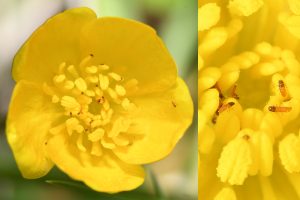
Oil beetle lifecycles are truly fascinating. They are nest parasites of solitary bees, which they need to complete their lifecycle. After mating, the female oil beetle digs a nest burrow in bare soil and lays hundreds of eggs. These hatch out into tiny larvae called triungulins which then leave the nest and climb up onto a nearby flower head to lie in wait for a passing solitary bee. When a bee visits the flower to collect pollen and nectar, the triungulins grab onto the bee with their hooked feet and hitch a ride back to the solitary bee’s nest. Once in the nest the triungulins then proceed to eat the bee’s eggs and its stores of pollen and nectar, and develop into the adult beetle underground. When fully grown, the adult beetle will then emerge from the nest ready to start the cycle all over again.
Conserving and recording oil beetles
Oil beetles need solitary bees which in turn need wildflowers for pollen and nectar. Looking after our species-rich grasslands is therefore crucial to protecting our oil beetle species. Recording oil beetles is important in understanding how they are doing. If you spot one, take a photo and submit it to the National Oil Beetle Recording Scheme.
Fascinating fact
Oil beetles lay hundreds of eggs as not many will make it to adulthood. Triungulins will grab onto anything that visits the flower… so it may not be a solitary bee or a female going back to a nest – it’s a bit of a gamble!
Author: Jennifer Gilbert – Farm Environment Adviser.
Photos: Jennifer Gilbert and Liam Olds.
For more identification help visit the Buglife website here.