

Richard Hollis – Farm Environment Adviser
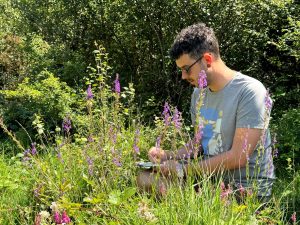 Lowland heath is a fantastic habitat growing on free-draining, acidic soil which is something we have in abundance where I am based in Cornwall. Of course, it’s characterised by low growing shrubs, different species of heathers and gorses. These come into their own in late summer and give us hillsides and clifftops carpeted in a variety of pinks and yellows. But it’s during spring where an array of wildflowers can be found, many of which wouldn’t be out of place in an alpine or rock garden and each like a small jewel growing out of the grasses.
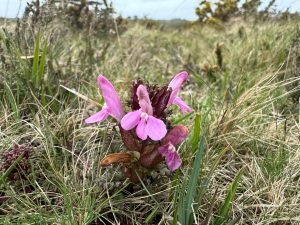 Lousewort
You may be more familiar with this plant’s close relative, Yellow Rattle, Rhinanthus minor. Just like the well-known meadow-maker, Lousewort, Pedicularis sylvatica, is a hemiparasite. This means that as well as producing its own food through its leaves, it taps its roots into other plants, in particular grasses, through a structure called a haustorium to steal nutrients and water. This action reduces the vigour of the grass it’s tapped into and gives space for other wildflowers to grow. It tends to be low-growing with lobed leaves that are flushed with purple. Lousewort’s bright pink flowers are found throughout spring and have a very distinctive shape with a hood bearing two teeth above a lower lip divided into three lobes.
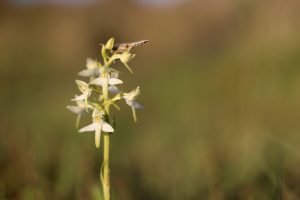 Lesser Butterfly Orchid
One of my favourite wildflowers to find out on the heath in late spring is the Lesser Butterfly Orchid, Platanthera bifolia. This plant holds a wonderful flowering spike; these flowers are a delicate blend of lime green, ivory and pure white. I’m not entirely sure I see the butterfly resemblance to the individual flowers, perhaps a moth with a long body and thin wings but I’ll leave that to your individual imaginations. It’s no accident that these flowers are white as they are used to attract nocturnal moths, with the white colour keeping its vigour in the low light and reflecting pale moonlight brilliantly. A soft fragrance is also released in the evening that is not present during the day, so one to enjoy on a warm, sunny, late afternoon walk.
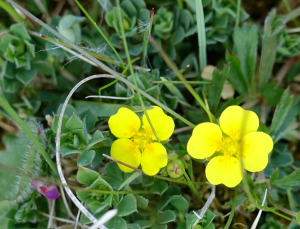 Tormentil
Shining bright yellow in the short green grass, Tormentil, Potentilla erecta, is not a shy and retiring flower, but sociable and hard to miss. Despite its scientific name, it is typically low-growing in the UK, and you can often find it alongside other heathland wildflowers like Lousewort and Heath Bedstraw, Galium saxatile, which is a plant with very small white flowers with only 4 petals in a cross-shape. Tormentil too typically has only four petals, but these are bright golden yellow and very broad, contrasting wonderfully against the dark green foliage.
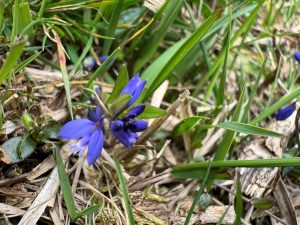 Heath Milkwort
There are very few truly blue flowers, but Heath Milkwort, Polygala serpyllifolia, comes very close indeed. When you see them out on the heath, they look like little blue gemstones spilled across the floor. If you can get a closer look at them, you’ll see a beautifully structured flower with two large, wing-like, blue/deep purple sepals and an inner tube which is a paler purple and deeply fringed at its tip. There are a few lookalike milkworts, but Heath Milkwort can be identified firstly by its habitat on acidic soils as well as the leaves changing in placement as they move up the stem. The lower leaves are in opposite pairs which fade to alternate as they progress towards the flower.