
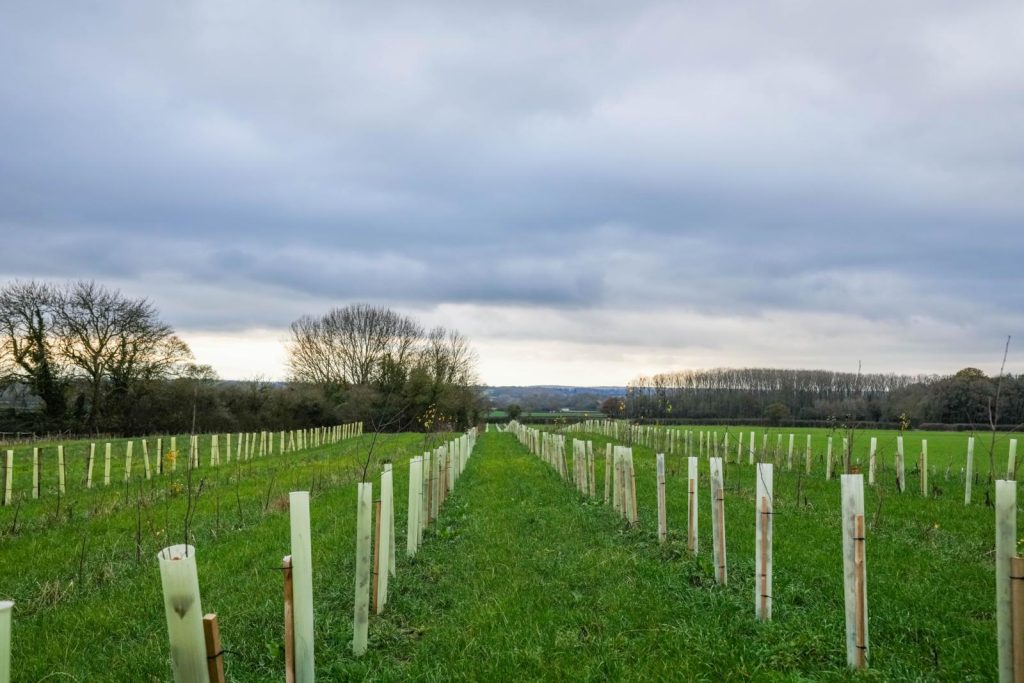
At the recent Agroforestry show, supported by the Woodland Trust and Soil Association, the trees team had a good look round all stands to check out the merchandise. We took a deep dive into tree guards and suppliers, especially as we start to ramp up the advice for new woodlands and agroforestry plots.
The range was minimal, however, there are new products on the market for the eco-conscious tree growers, in particular, those guards made from recycled or sustainable products such as pulp, cotton, potato starch and ocean-bound plastics. I believe that although we might raise our eyes with some of these products and question their sustainability, they are trying to do the right thing. Let’s face it, one of the biggest issues is removing the tree guards after they have outgrown their purpose and putting them in the recycle bin! These new products could provide the answer for the busy farmer…!
Breaking it down, the reasoning behind these recycled products is that the plastics are hard to recycle in our current system; they get left in the field and found some years later or get left on the tree. Producing the guard that naturally breaks down and enters into our soil system is more environmentally sound, but does come at a cost to the land owner.
Let’s talk details: on average tree planting is usually in the thousands in our farming systems and so finding the right product and then ensuring the conscious recycling of those products should be important to us all. The range of products spans from 40% recycled plastic guards – namely Tubex (tubex.com) which has a long-standing reputation, is reliable and relatively cheap, plus they will recycle your guards for free; there is also a Tubex ‘Nature Guard’ made from sugarcane, corn and starch – to something much more robust and nuanced such as the ‘Tree Hugger’ (https://amenity.agrovista.co.uk/product/tree-hugger-biodegradable-shelters), made of UK-grown organic cotton dipped in FSC pine resin to increase rigidity. This new product claims to be designed to transmit light across the full range of the visible spectrum (from violet to red) but with specific adjustments to benefit plant growth. Great news for eco-conscious growers, this guard has a minimum life span of 5 years, however, these come at a price and individual enquiries should be made to make your own decisions. An alternative is ‘Vigilis-Bio’ (vigilistreeshelters.com): this company offers a range of products and their new bio product is made from potato, maize and wood, very beige in colour, and claim 5-6 years of protection with a soil conditioner lasting 2 years as it degrades. I could not find any evidence of what those minerals were and whether they had a beneficial amount of nutrition that benefits the tree growth, so we will have to rely on their research and claims for now.
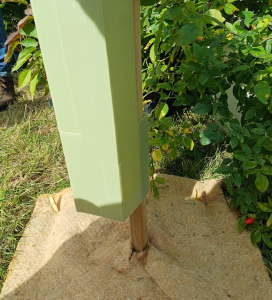
There were the usual round guard shapes and now some square with the stake on the inside of the guard. A guard by Rymer Trees called the ‘Tree Defender+’ claims to be harmless to the environment, is made from 100% recycled and sustainably sourced UV-stabilised polypropylene. The good thing about these guards is that the shelter can be lifted and quickly checked to see if the plant is still alive as there is no cable tie. It can be delivered as a flat pack.
Most guards are now being sold in a wrap version so rather than it slotting over the top of the tree it can be wrapped round them – very useful if you have ever planted a lot of trees and I would recommend sourcing guards that have this characteristic, if the price is right! Cable ties – only one type was biodegradable and those are available from Cheviot Trees, Vigilis etc, or can be purchased online. It is worth discussing preferences with your supplier when you order the guards, stakes and other products to support your planting plan.
Finally, there is a strong movement towards not using tree guards at all, which would mean complete freedom and satisfaction of your impact on the planet. What does that look like in reality? In the absence of a robust and frankly quite costly deer fence requiring weekly monitoring to ensure no small deer have created a new hole, there is a chance that your woodland could thrive with a good deer management plan that is acted on. I would argue that a good population of predatory birds (raptors) to keep a tight control on your vole populations might be useful and a case for habitat restoration explored through other grants available. Overplanting might be a way to accommodate for browsing: this practice has been used mainly in
 research and development projects by creating a mantle around the prized tree. This would not work for EWCO or in the Woodland Tree health grants as you have to maintain the trees for the first 15 years and replace any that die.
There is ongoing research with the Woodland Trust on the robustness of tree guards made from recyclable products (available on their website). This is great research, and one hopes that with greater purchasing of these products it might bring the price down… or is that wishful thinking? Either way planting trees supports the government’s 25 year environmental plan to reach net zero by 2050 and is currently supported by grants such as WCPG and EWCO as well as lots of planning grants to get you on the move towards designing the planting plan. It is also a very satisfying way to bring down your own carbon emissions on the farm and increase the wildlife across the farm through linked hedge corridors!
As always FWAG advisers are on call to help you make the right decision for your farm. Please get in touch with the FWAG SW Tree Team to help you decide on your next steps: trees@fwagsw.org.uk
Author:
Joanne Leigh – Senior Farm Environment Adviser