

What is a Moor Association?
Moor Associations (MAs) are groups of people who farm and own the land on their Moor, who act as a collective body to action change, lobby, and share information. They are farmer led and work together to address local issues and manage their landscape to deliver the best outcomes, as defined by them.
Land ownership on the Somerset Levels and Moors is highly fragmented, and even moderate scale changes require collaboration between many different people. Moor Associations bring farmers and landowners together and allow them to speak with a united voice, collaborate on projects, and action change across their moor. They also provide a single point of contact for government bodies and other stakeholders, allowing greater communication between government bodies and farmers on the ground.
Their long term objectives are to:
- Overcome the barrier of fragmented land ownership
- Allow private landowners on the Somerset Levels and Moors to input into policy discussions
- Facilitate bottom-up land use planning and change
- Create resilience
- Provide a single point of contact
History
Developed and facilitated by FWAG South West, and funded first by Co-Adapt Interreg with match funding from the Somerset Rivers Authority, and currently by the Somerset Rivers Authority alongside DEFRA funded projects, there are now 13 Moor Associations across the Somerset and North Somerset Levels and Moors, including 200+ landowners over 10,000 ha. A Board of Moor Association Chairs has also been established.
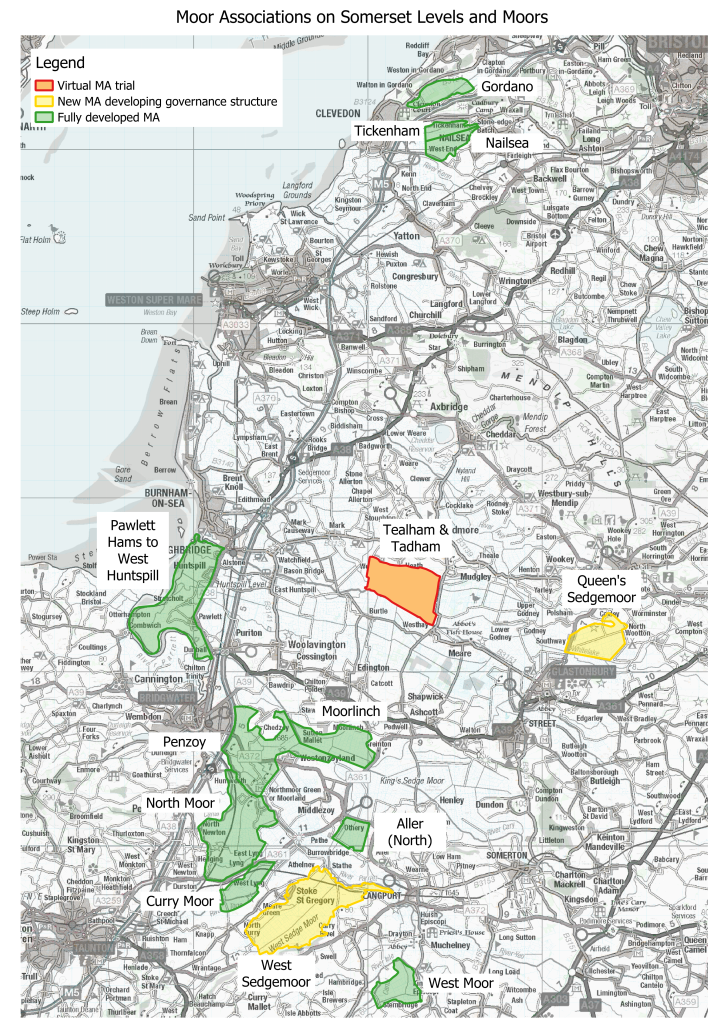
Above: Map of the Moor Associations of the Somerset Levels and Moors
Successes
Individual Moors:
Current successes on individual moors include members contributing funds for shared drove maintenance, the collective purchase of machinery, and the delivery of a collaborative Environmental Land Management Schemes (ELMs) test & trial. The Environment Agency, Internal Drainage Board, and Natural England have also visited the Moor Associations to discuss a range of topics, including flood risk management and biodiversity.
The team at FWAG SW bring our industry expertise to the meetings, researching any issues that the members raise, and assist the MA members with administration such as inviting speakers, venue hiring, and taking minutes.
Underpinning Delivery of Projects:
As well as meeting regularly to discuss local issues, Moor Associations have also been instrumental in the delivery of a variety of other projects, including the Greater Sedgemoor Landscape Recovery Project, and Lowland Agricultural Peat Water Discovery Pilot.
- To find out more about the impact of the Moor Associations on the Greater Sedgemoor Landscape Recovery Project please click here.
Co-Designing Land Use Planning Processes:
Through the Water Discovery Pilot, a working group of Moor Association farmers from across Somerset and North Somerset developed a consensus-building model that can be followed by groups of farmers working together to create ‘whole moor’ land use plans covering a hydrological block (an area of land controlled by the same water management infrastructure). This model was the basis for collaboration and consensus building in the Greater Sedgemoor Landscape Recovery project.
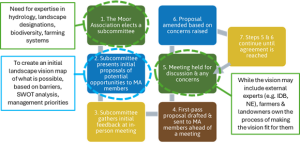
Figure 1 Decision-Making Model
For more information on the model development see Somerset Moor Futures: Co-Designing Whole Moor Planning
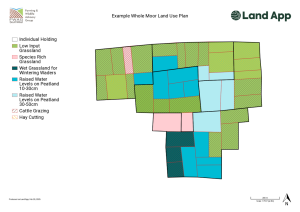
Figure 2 Example Whole Moor Land Use Plan
A group of MA farmers in North Somerset also helped to drive the creation of a landscape visioning process to locate opportunities in the landscape in a way the balances a variety of priorities, including farming and food production, resilient businesses, carbon storage, flood risk management, biodiversity enhancement, and water quality issues. This is a powerful tool to assist collaborative spatial planning at a moor level scale.
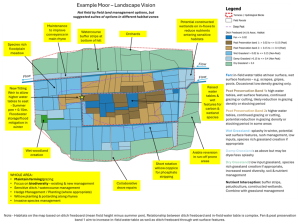
Figure 3 Example Landscape Vision
Hear from farmers, Jonathan Coate and Gerald Venn about farming on the Somerset Levels and the importance of Moor Associations.
Project Lead/Contact:
Will Barnard – email: will.barnard@fwagsw.org.uk
Anna Lantaff – email: anna.lantaff@fwagsw.org.uk